Every franchise network with delivery has the same quiet line item: the slice of every order that goes to Uber Eats, DoorDash and their kind. This article walks through what an aggregator order really costs, where the aggregators earn their keep, and the playbook for moving your regulars onto your own channel, store by store.
An aggregator order hands a published commission of roughly 15 to 30 percent of the order value, plus GST, to the marketplace, and keeps the customer relationship there too. A direct order keeps the margin and the customer. Neither channel is evil and neither is free. The problem is proportion: most networks pay discovery prices for customers they already own.
This is a local problem wearing a national costume. National campaigns fill the aggregator apps; what moves a suburb's regulars to a store's own ordering page is local store marketing, done consistently, per store. That is the job a franchise marketing platform exists to do, and the rest of this article shows the maths and the playbook.
Both big aggregators in Australia sell three-tier plans, and the tiers trade commission for visibility: the more you pay, the more the app promotes you. Published delivery commissions run from around 15 percent on entry tiers to around 30 percent on the top tiers, plus GST, with pickup orders around 6 percent. Paid placement inside the app, sponsored listings and their cousins, is charged on top on the lower tiers. Those are the platforms' published plan structures as at August 2026; rates change and individual agreements vary, so always read the current rate card.
Around $15 of it goes to the aggregator before GST, food costs, packaging or a single staff hour. The store fulfils the order and banks what is left.
Card processing of roughly 1 to 2 percent, so around a dollar, plus your own fulfilment. The rest stays in the store, and so does the customer record.
Call it $13 or more per delivery order. On a store doing hundreds of aggregator orders a month, that gap is a wage. On a network, it is a P&L line.
And the commission is only the visible cost. The aggregator also keeps the customer: their contact details, their order history, their habits. The store cannot email them, cannot invite them back, cannot even recognise them. Many stores respond by inflating menu prices in the app, which quietly teaches customers that the brand is expensive. The full picture of what the current arrangement costs sits next to the other numbers on what it costs to do it another way.
An honest version of this article has to say it: the aggregators are good at things that are expensive to build. They put your brand in front of people who have never tried it, on the night those people are hungry and undecided. They bring a courier network you do not have to roster. They soak up demand at times your own channel is quiet, and they can carry a brand new store while the suburb learns it exists.
The trap is not using aggregators. The trap is paying discovery prices for people who no longer need discovering. The customer who orders from the same store every Friday does not need to be found; they need a shorter path to the store itself. Every network's aggregator bill is really two bills stapled together: a fair one for finding new customers, and an unnecessary one for renting back its own regulars. The play is to keep the first and shrink the second.
No single tactic does it. Networks that shift meaningful volume run the same handful of moves together, per store, for months, not as a one-off campaign but as the default way each store markets.
A direct-only offer beats a commission on the same order. Ten percent off direct costs less than a top tier commission, and the customer lands in your system, not theirs.
Ads in the store's own trade area, pointing at the store's own ordering page rather than an app listing. See delivery area targeting.
Boxes, bags, flyers, posters, the counter. Every aggregator delivery is a chance to convert the next order to direct, in the customer's own kitchen.
Organic posts from each store's Facebook and Instagram, always linking direct. Free reach that compounds. See organic social.
When someone searches the brand plus their suburb, the click should land on the store's page, not on a marketplace listing with a commission attached.
Direct share only moves if someone watches it move. Per store reporting shows which stores push and which quietly coast on the apps.
The playbook gets concrete here. These are three direct-order campaigns a head office can build once and every store can run, shown as example ads for a fictional brand. In each one the store name and the voucher code are the store's own: Amplaro drops them into the locked artwork automatically, so the Paddington store's ad carries PADDO20 and the next suburb's carries its own. Because every code is unique per store and per campaign, the redemption counts in your ordering system line up store by store with the spend and clicks in the reporting.
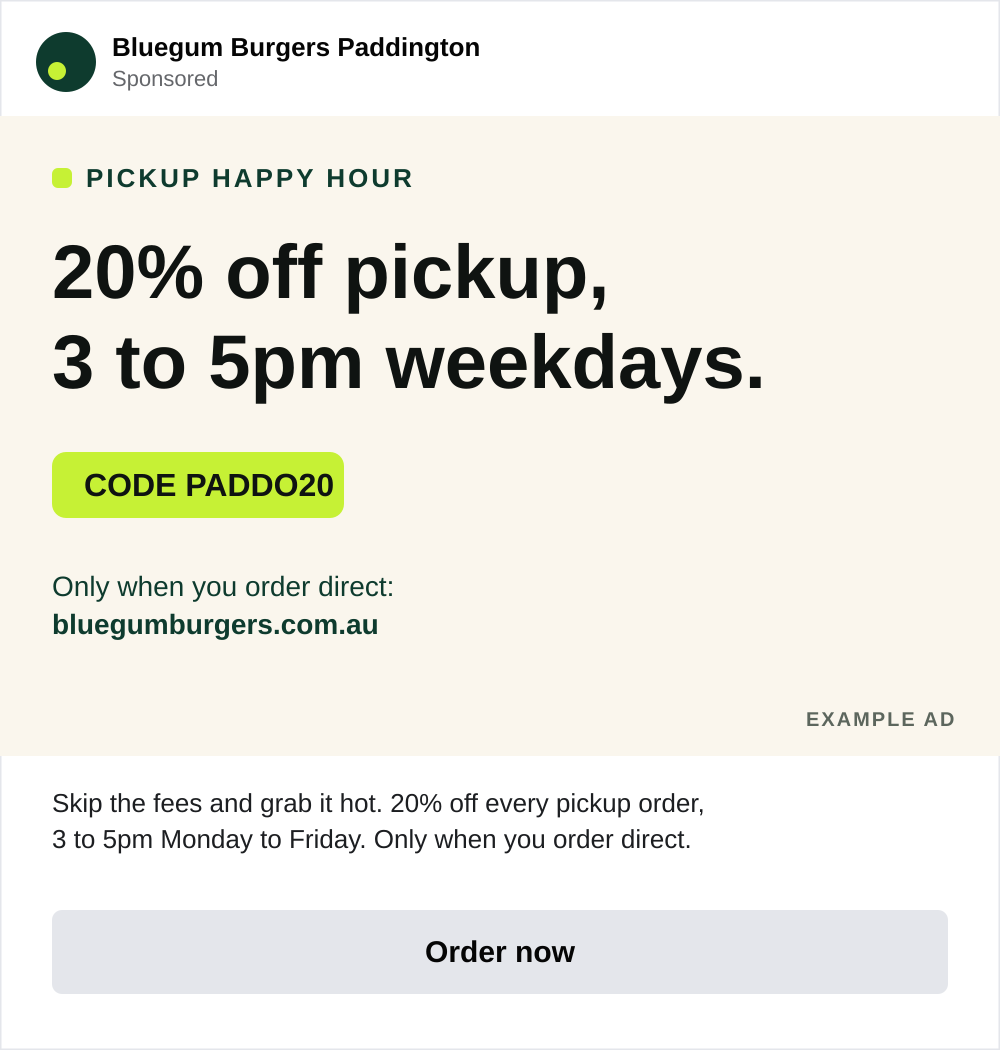
20% off pickup orders, 3 to 5pm on weekdays. It fills the quietest daypart, and pickup skips delivery costs entirely, so the margin survives the discount. Runs as Meta feed and story ads inside the store's own zone, with the schedule locked to the happy hour so the budget only spends when the offer is on.
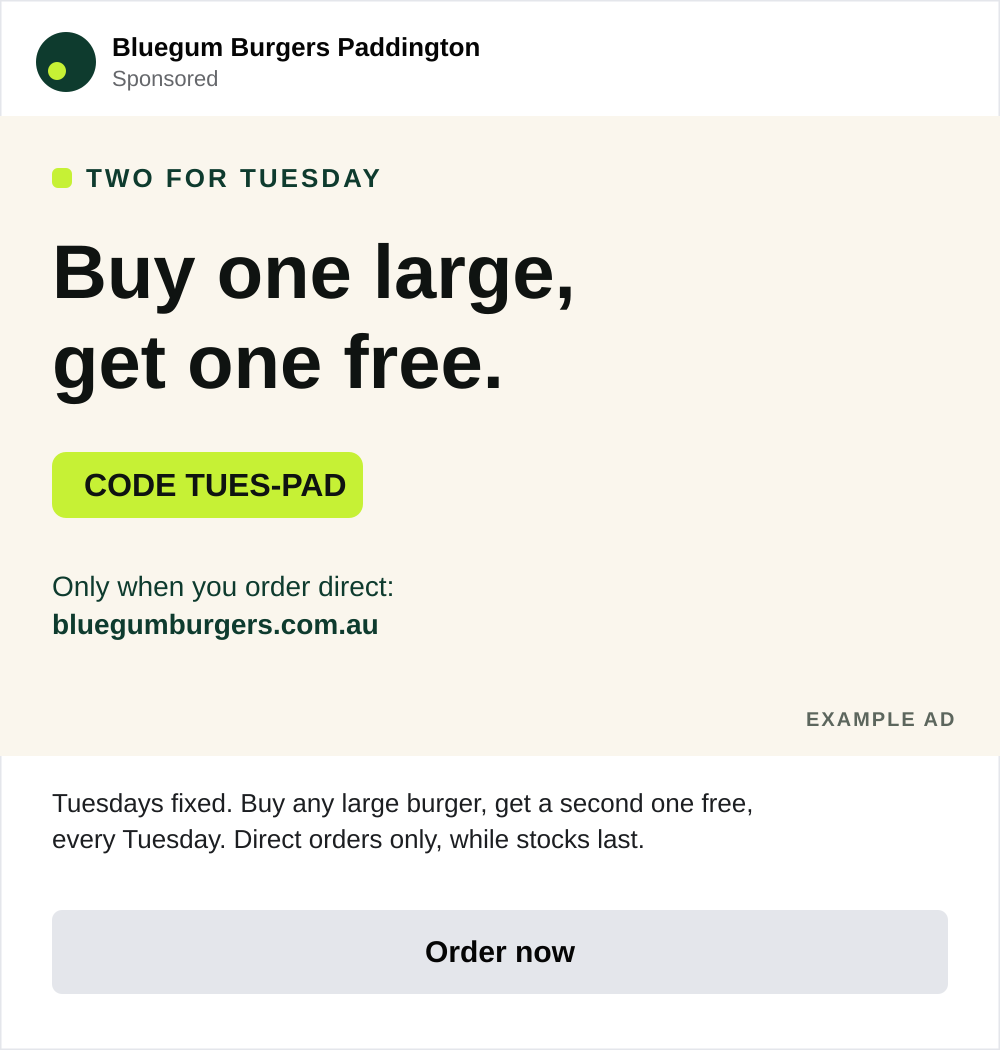
Buy one, get one free, every Tuesday, direct only. A fixed weekday builds a habit: customers learn the day, the kitchen can plan the prep, and the quietest night of the week gets its own reason to exist. The code carries the store tag, so head office can see exactly whose Tuesdays are moving.
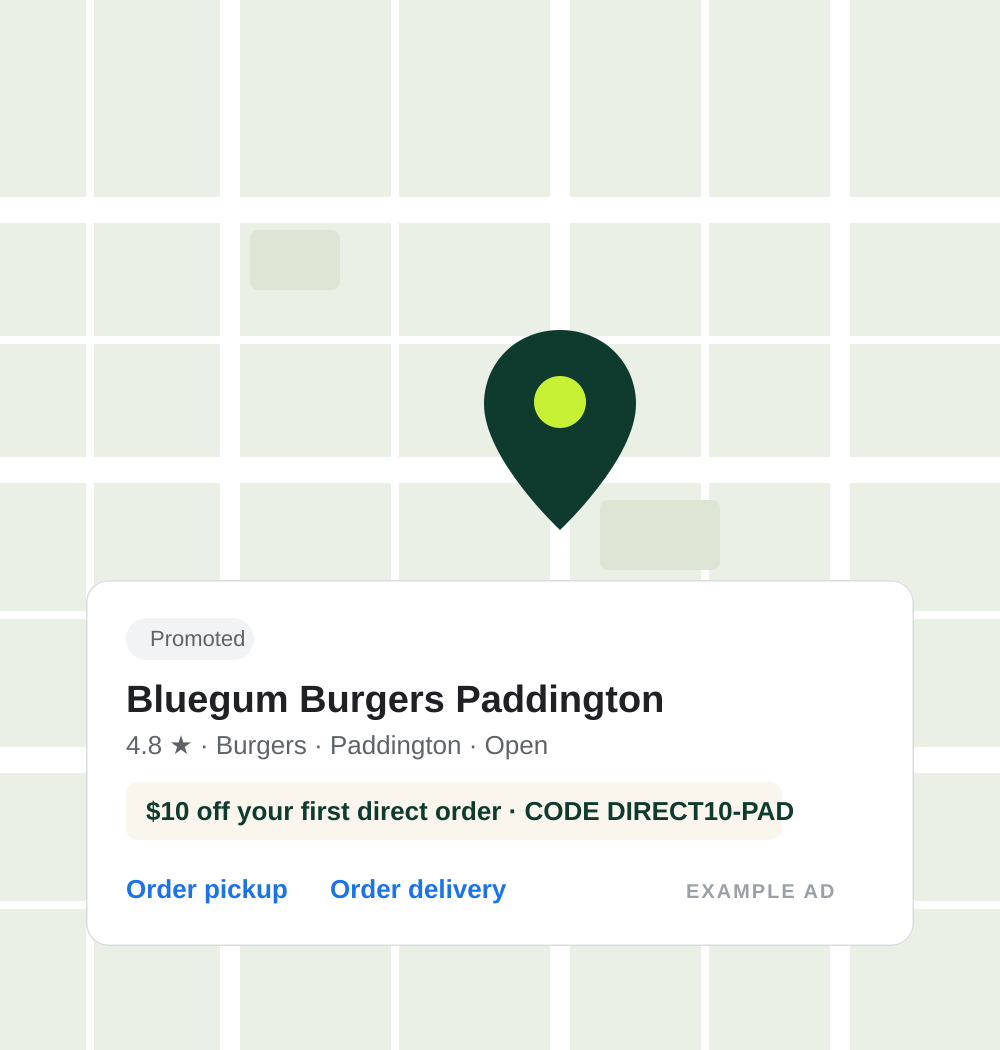
$10 off your first direct order, aimed at people who already buy through the apps. It shows up on Google Maps when locals search nearby, in zone ads, and as a QR on every box that leaves the store. One redemption pays for itself against a single top tier commission, and the customer is now yours.
Every play is a package: head office locks the artwork, the offer, the schedule and the budget range, and partners launch it for their own trade area in minutes, on Meta, Google and print from the same order. The creative above is a made-up brand, but the mechanics, store name and code stamped into locked artwork in the brand font, are exactly how brand control works.
The plays answer what to run. Just as important is who runs what, because the most expensive mistake in franchise media is the same brand bidding against itself: head office and a store landing in one auction, or two stores buying each other's suburbs. These four splits give every dollar exactly one lane.
Head office runs the national layer: the brand's own name and the broad generic terms, one bidder for the whole country. Partners use Amplaro for the local layer: campaigns inside their own zone, including the comparison searches people make when a local rival is the alternative. Two guardrails keep it clean: competitor names belong in keywords, never in ad copy, and fitted zones mean no two stores ever buy the same suburb. One bidder per auction, everywhere. The budget logic behind this sits on local vs national.
Head office owns the reach channels: TV, national video, the brand's main social accounts. Partners own the last three kilometres: Meta feeds and stories in the zone, Google Maps, the store's own pages, and the letterbox. Nothing overlaps because the surfaces themselves are divided, and the local layer lives on the surfaces national spend rarely saturates. A household sees the brand nationally and its own store locally, and those are different jobs.
The national promotion calendar belongs to head office. Partners fill the quiet weeks in between with the always-on local plays above, the happy hour and the activation day, and step back when the national wave lands. One owner per week: head office locks the windows into the packages, so no partner can accidentally run a deeper discount against a national offer, and no national burst competes with a store's own push.
When a rival opens near one store, the answer should be surgical, not network-wide. That store runs a pre-built defence package inside its own zone for a few weeks: best sellers, a welcome-back offer, a direct-only code. The rest of the network spends nothing on it. Without a platform this takes an agency brief and a fortnight; with one, it is a partner activating the campaign head office built for exactly this day.
The common thread: every auction, surface and week has exactly one owner. Amplaro is what makes the store side of each split real. Partners run their lane without becoming marketers, the guardrails stop anyone bidding outside their zone or off the brand, and head office watches both layers land in the same report.
Every move in that playbook is local, which is exactly why it usually does not happen: nobody expects a franchise partner to build ad campaigns, and head office cannot hand-run marketing for every suburb. Amplaro packages the push once at head office: the artwork in the brand font, the direct-only offer, the budget limits, the dates. Each partner picks it up, adds their store name and voucher code inside locked guardrails, and launches it for their own trade area in minutes. The ads point where head office aimed them: the store's own ordering page.
The targeting is the part we can prove. Amplaro fits ad audiences to each store's real delivery area instead of a radius. On 970 measured zones, a single covering circle put a median of about two thirds of its area outside the zone, while the fitted Meta targeting put 12.4% outside at 92.6% coverage. When the whole point of the spend is to fund your own channel, the share of it that lands on households you can actually serve decides whether the maths works. The numbers and method are on the zone benchmark. The same order flow covers printed flyers and posters with a per store QR code and scheduled posts to each store's own pages, so the whole playbook is one catalogue, not five tools.
One honest boundary: Amplaro is not an online ordering system. It is the marketing layer that fills whichever direct channel your network already runs, and the reporting that shows head office which stores are moving their mix. How the pieces fit is on how it works.
Round numbers for one store, so you can swap in your own. Take a store doing 300 aggregator delivery orders a month at a $45 average, on a top tier plan.
| Line | Number | Working |
|---|---|---|
| Order value through the apps | $13,500 a month | 300 orders at $45 |
| Commission at a 30% tier | about $4,050 a month, plus GST | before any in-app ads |
| Move a quarter of orders direct | 75 orders a month | regulars, not new customers |
| Commission avoided | about $1,010 a month | 75 x $45 x 30% |
| Over a year | about $12,000 per store | before the cost of moving them |
Swipe the table sideways on a phone.
What does moving them cost? A modest weekly local ad budget, the margin you give away in a direct-only offer, and some QR stickers. Those costs are real, and they still sit far below the commission they replace, because the offer is a one-off per order while the commission repeats forever. Multiply by the stores in a network and the yearly number stops being a store tweak and becomes a network strategy. This is an illustration at published top tier rates, not a forecast; the honest way to use it is to rebuild it with your own volumes, and the return on local marketing covers how to judge the result without fooling yourself.
For most networks, no. Aggregators are a real discovery channel and a real fulfilment network, and walking away from them usually means walking away from orders. The goal is proportion: keep the aggregators for finding new customers and covering demand you cannot serve yourself, and move the regulars, the people who already know the store, onto the direct channel where the margin lives.
Usually, yes, because the two numbers are not close. A commission on a top tier plan takes around 30% of the order, plus GST. A direct-only offer of 10 or 15 percent costs half of that or less on the same order, and the customer it wins is now in your own system: you have the order history, the consent to contact them, and no per-order fee next time. The discount is a one-off cost; the commission repeats on every order forever.
They do a different job. Paid placement inside an aggregator fights for people who already opened the app and are choosing between you and the store next door, and it is charged on top of the commission. Local ads in your own suburbs reach households before the app is open and land them on your own ordering page. Both can have a place, but only one of them builds a customer base you own.
Yes. Direct simply means an order where no marketplace sits between you and the customer: your own website ordering, a first party ordering tool, click and collect, or the phone. Amplaro is not an ordering system and does not want to be. It is the marketing layer that fills whichever direct channel your network runs, store by store.
The maths is sharpest in food delivery because the commissions are highest there, but the pattern is general: wherever a marketplace sits between a store and a repeat customer and charges per transaction, moving the regulars to a direct relationship changes the store's economics. Booking platforms and service marketplaces rhyme with the same logic. The sector versions start at franchise industries.
By packaging it. Head office builds the campaign once: the artwork in the brand font, the direct-only offer, the budget limits, the dates. Every store activates it for its own trade area, adds its own store name and voucher code inside locked guardrails, and head office sees every campaign, every store and every dollar in one report, including the stores that have not launched it. That is the core of what head office keeps.
For where the direct push sits in the bigger budget picture, see local vs national. For the fast food version of local marketing end to end, start with QSR local marketing.
The sector page: delivery areas, dayparts and limited time offers, per store.
Measured: what a radius wastes and what fitting the real zone saves, on 970 zones.
Designer hours, agency fees, wasted spend and commissions, added up properly.
Bring your aggregator volumes and one store's delivery zone. In a demo we fit the zone, build the direct-orders package, and you can rebuild the maths table above with your own numbers before anything spends a dollar.